
Audit Trail Architecture — What a Defensible System Looks Like
An audit trail that exists but is never reviewed is not a compliance control — it is a liability waiting to be discovered by an FDA investigator who will review…
On this pageArticle overview
An audit trail that exists but is never reviewed is not a compliance control — it is a liability waiting to be discovered by an FDA investigator who will review it more thoroughly in one inspection than your QA team has in five years.
That observation describes the actual state of audit trail governance at a significant proportion of FDA-regulated pharmaceutical facilities operating today — not because the technical infrastructure is absent, but because the organizational governance surrounding that infrastructure was never built. The audit trail is enabled. The system captures user IDs and timestamps. The configuration has been validated. The vendor qualification is on file. And none of that investment in technical capability translates into regulatory protection if the audit trail has never been reviewed on a defined schedule by a QA function independent of the data it monitors, and if batch record release has never included a formal step in which someone in QA confirms that the audit trail for the record under review is complete, consistent with the manufacturing timeline, and free of unexplained modifications. The technical capability to capture data events is the floor, not the ceiling, of a defensible audit trail system. What FDA investigators assess during an inspection — and what most companies have failed to build — is the operational governance program that transforms a configured audit trail into an active quality control.
Before addressing how an audit trail should be reviewed, it is worth acknowledging the technical architecture that makes review possible in the first place — because an audit trail that cannot be archived and restored without breaking chronological integrity, or that does not distinguish between data-level events and system-level events, is not a reviewable record regardless of how thorough the review SOP is. The XGene framework addresses the operational governance of audit trails that are architecturally defensible; if the system itself lacks separate system and data audit trails, native archive/restore capability, and electronic documentation of review, the governance program cannot compensate.
What a Technically Complete Audit Trail Requires: The Metadata Fields FDA and EMA Both Inspect
The technical completeness of an audit trail is defined by what the system captures, and the regulatory requirements from FDA and EMA specify that standard with enough precision to make the gap between compliant and non-compliant systems identifiable on inspection. Under 21 CFR Part 11.10(e), electronic systems used to create, modify, maintain, archive, retrieve, or transmit electronic records that are subject to GMP requirements must use secure, computer-generated, time-stamped audit trails to independently record the date and time of operator entries and actions that create, modify, or delete electronic records — and the audit trail documentation must be retained for a period at least as long as that required for the subject electronic records and must be available for agency review and copying. The EU GMP Annex 11 Clause 9 aligns with this requirement and adds the explicit specification that consideration should be given to building in the creating, modifying, and deleting of GMP-relevant data — including the reason for any change. WHO TRS 996 Annex 5 (2016) and the MHRA GMP Data Integrity Guidance (2018) both build on this foundation to describe the metadata minimum: the audit trail must capture, for every relevant event, the user identity of the operator who performed the action, the workstation or system identifier from which the action was taken, the date and time stamp synchronized to a validated time server, the event type (creation, modification, deletion, access), the object or record affected, and — for modification events — both the original value prior to change and the new value after change together with the reason for the change. For deletion events, the original record content, the reason for deletion, and the user identity must be captured, and the original record must be recoverable. Access events for restricted or privileged data must also be logged with user identity, timestamp, and object accessed.
The FDA Guidance for Industry: Data Integrity and Compliance with Drug CGMP (2018) operationalizes these requirements in the GMP context by specifying that audit trail records must be available for review by FDA during inspections and that systems in which the audit trail can be disabled — by any user including system administrators — do not satisfy the regulatory requirement. This is a point of significant technical consequence. In systems where an administrator-level account has the ability to pause, disable, or clear the audit trail without generating an unalterable log entry for that action, the audit trail’s independence is compromised regardless of how completely it otherwise captures data events. GAMP 5 (ISPE) addresses this in the context of computerized system validation and specifies that audit trail configuration must be part of the validated state of the system — changes to audit trail scope or configuration must themselves be captured and must require change control authorization. The system architecture requirement is that modification of the audit trail must be detectable: any attempt to alter, delete, or truncate the audit trail record itself must generate a logged event that cannot be suppressed, and the audit trail storage must be independent of the data records it monitors so that a compromise of the primary data store does not affect the integrity of the audit trail record.
Under 21 CFR 211.68(b), electronic equipment used to generate and manage GMP records must produce records that are accurate and complete — and the completeness of those records, including the completeness of the audit trail generated by that equipment, is subject to verification during FDA inspection. The combination of 21 CFR 211.68(b) and 21 CFR Part 11.10(e) means that the technical completeness of the audit trail is a CGMP requirement with enforcement consequences independent of any data integrity finding. A system that is technically configured to capture all required metadata fields, whose audit trail storage is independent of the data it monitors, whose configuration cannot be altered without change control, and whose time stamps are synchronized to a validated time server meets the technical standard. Most systems deployed in regulated pharmaceutical manufacturing meet that standard today — the deficiency that drives FDA findings is not in the technical architecture but in the operational program surrounding it.
The technical architecture decision with the most significant operational consequence is whether a system implements a single audit trail or separate system and data audit trails. A single audit trail records both configuration‐level events — user account management, instrument connections, software updates — and data‐level events — creation, modification, and deletion of analytical results. This design works for archival but creates a substantial review burden because data‐level events must be extracted from a record that also contains system‐level events. The more robust design separates system and data audit trails, allowing data‐level events to be archived and restored independently of system configuration history. That independence matters because the data audit trail must be preserved with its chronological integrity intact for the full record retention period, independent of whether the system that generated it is still in service. A system that does not support native archive and restore of data‐level audit trails produces a record that is technically compliant at capture but functionally unreviewable after system decommissioning, because the chronological relationship between data entries cannot be reconstructed from a flat file export.
The requirement for electronic documentation of audit trail review is equally consequential. A reviewer who conducts an audit trail review but documents the outcome on paper — or in a separate system not linked to the audit trail itself — creates a hybrid record that cannot be traced to the specific data set reviewed. The defensible design, which very few commercial CDS platforms implement natively, is a system function that allows the reviewer to record the review conclusion and the scope of review directly in the audit trail, producing an electronic record of the review that is contemporaneous, attributable, and searchable. Without that function, the review program is operationally incomplete regardless of how frequently reviews are scheduled.
The Review Gap: Why Captured Audit Trails Without Active Review Programs Fail Inspection
EU GMP Annex 11 Clause 9 does not merely require that audit trails be configured and retained. It requires that they be regularly reviewed. The word “regularly” in that clause is not ornamental — it is an operational requirement that obligates the regulated organization to define a review frequency, assign responsibility for the review, document the outcome of each review, and escalate findings through the quality system. Industry practice, informed by FDA and EMA expectations established over more than a decade of data integrity inspection and enforcement, has settled on at least quarterly review for critical GMP electronic systems as the baseline — with triggered reviews required for every deviation, every OOS result, every CAPA that involves a computerized system, and every event that calls the integrity of the data record into question. Quarterly review as an absolute minimum means that an audit trail event that occurred immediately after one quarterly review will have been in the record for up to thirteen weeks before the next scheduled review identifies it. That window narrows when triggered reviews operate as intended — every OOS investigation, every CAPA opened against a laboratory system, and every deviation involving computerized equipment should include an audit trail review as a defined step. The facilities where the review gap is largest are the ones that have defined a quarterly review schedule but have never operationalized the triggered review requirement: OOS investigations are conducted without ever opening the audit trail for the system that generated the anomalous result, and CAPA programs address procedural and training deficiencies without assessing whether the audit trail contains evidence of the systemic data handling practice that produced the deviation.
The independence requirement for audit trail review is as important as the frequency requirement and is more consistently absent in facilities where the review program exists in name but not in practice. An audit trail reviewed by the same analyst who generated the data it contains is not an independent review — it is a self-assessment, and it carries no assurance value as a quality control. Under the data integrity guidance from both FDA (2018) and MHRA (2018), audit trail review must be conducted by personnel who are independent of the data generation activity. In a pharmaceutical quality organization, that means QA — not the analytical laboratory, not the manufacturing department, and not the supervisor of the function whose data is under review. The organizational design of the audit trail review program must ensure that the reviewer has no operational accountability for the results under review, has no performance incentive tied to the disposition of the batch whose data is being reviewed, and has the authority and the institutional expectation to escalate a finding without organizational pressure to resolve it quietly.
The review scope per batch record is the dimension that most directly connects audit trail governance to the release decision. A review program that operates on a periodic schedule — quarterly, monthly, or even weekly — without integrating audit trail review into the batch record release process leaves a structural gap in the quality system: batches can be reviewed and released without anyone having confirmed that the audit trail for the electronic records supporting that release is complete, consistent, and free of unexplained events. The audit trail review may happen, eventually, as part of the next scheduled periodic review — after the batch has been released, after the product has been distributed, after the patient has potentially received it. Annex 11 Clause 9 and the FDA 2018 guidance both support the position that audit trail review scope should be proportional to the risk of the system and the criticality of the data, and that for data directly supporting batch disposition, the review should occur before the disposition decision is made. That is the integration point between the technical audit trail capability and the quality governance program that makes the audit trail a release control rather than an archival record.
The failure mode that FDA investigators find in facilities that have periodic audit trail review programs but not batch-level integration is the same failure mode in every variant: the QA reviewer who performs the quarterly review is looking at a three-month accumulation of audit trail data, cannot reasonably connect individual audit trail events to the specific batches they supported, and produces a review record that notes “no significant findings” without the specificity or traceability that would make the review defensible under inspection. The audit trail was reviewed. The evidence of the review is documented. But the review did not confirm, for any specific batch, that the data supporting the release decision was complete and consistent at the time that decision was made. An FDA investigator who asks to see the audit trail review for a specific batch — a batch that generated an OOS result six months after release, or a batch that appears in a product complaint investigation — will not be satisfied by a quarterly review record that covers that batch within a ninety-day window without batch-specific documentation of the review findings.
Time Server Synchronization and Audit Trail Independence: The Technical Architecture Details That Matter
The technical architecture requirements for a defensible audit trail system reduce to three properties: completeness of capture, integrity of the record, and independence of storage and review. Completeness of capture has been addressed in the regulatory citation context above — every creation, modification, deletion, and access event must be captured with the full metadata field set. Integrity means that the audit trail record is tamper-evident: any modification to the audit trail itself must be detectable, and the system architecture must prevent any user — including administrators — from disabling or clearing the audit trail without that action itself being captured in a log that cannot be suppressed. Independence means that the audit trail storage is physically and logically separate from the data records it monitors: if the primary data store is compromised, corrupted, or deleted, the audit trail record remains intact in a separate storage environment, and the audit trail review function is performed by personnel and processes independent of the data generation function.
The GAMP 5 framework provides the validation methodology by which these three properties are confirmed for regulated computerized systems. The audit trail scope — which event types are captured, which metadata fields are recorded for each event type, which user roles have the ability to configure the audit trail — is a validated parameter of the system, established during initial qualification and subject to change control for any subsequent modification. The validation documentation confirms that the audit trail captures the required event types, that the metadata fields meet the minimum specification, that the time synchronization is functioning and verified, and that the audit trail storage is independent of the data records. For commercial off-the-shelf software platforms, the supplier’s system description and the vendor audit report provide the baseline for the user’s validation — but the user organization retains responsibility for confirming that the validated configuration is maintained in the production environment and that the time server synchronization is operational rather than assumed.
Time server synchronization in a multi-system GMP manufacturing environment is a coordination challenge that many facilities manage inadequately. A facility operating HPLC systems, a LIMS, a batch execution system, an environmental monitoring system, and a laboratory information system typically has multiple independent time references — some synchronized to a centralized server, some running on local workstation clocks, and some configured during installation without explicit time server specification. When audit trail events from multiple systems need to be correlated — the HPLC analysis timestamp versus the batch execution record entry, the environmental monitoring deviation alert versus the manufacturing batch record timeline — inconsistent time references produce apparent discrepancies that may be entirely artifactual but that require investigation to resolve. The investigation consumes resources, creates documentation, and in the context of an FDA inspection, creates a narrative about the reliability of the facility’s electronic records that is difficult to walk back once it has started. The infrastructure investment required to synchronize all GMP electronic systems to a single validated time server is modest relative to the investigational cost of resolving time discrepancy findings during inspection. The validated time server is not an optional enhancement to the audit trail architecture. It is a foundational technical requirement, and its absence is a finding.
The audit trail independence requirement has a less obvious but equally important organizational dimension. The audit trail must not only be stored independently of the data it monitors — it must be reviewed independently of the function whose data it contains. This means that the QA function responsible for audit trail review must have direct access to the audit trail without routing through the laboratory management, must be able to extract the audit trail for any system and any time period without requiring assistance or authorization from the users of that system, and must have the technical knowledge to interpret what the audit trail records contain. A QA reviewer who cannot independently access the CDS audit trail without requesting an extract from the laboratory supervisor, or who cannot interpret the difference between a modification event reflecting legitimate reintegration and one reflecting result manipulation, cannot perform an independent review. The organizational governance of audit trail review must address both access and competency: the reviewer must be able to get to the data without intermediation, and must be able to assess what the data means without deferring to the function being reviewed.
The XGene Audit Trail Governance and Review Architecture
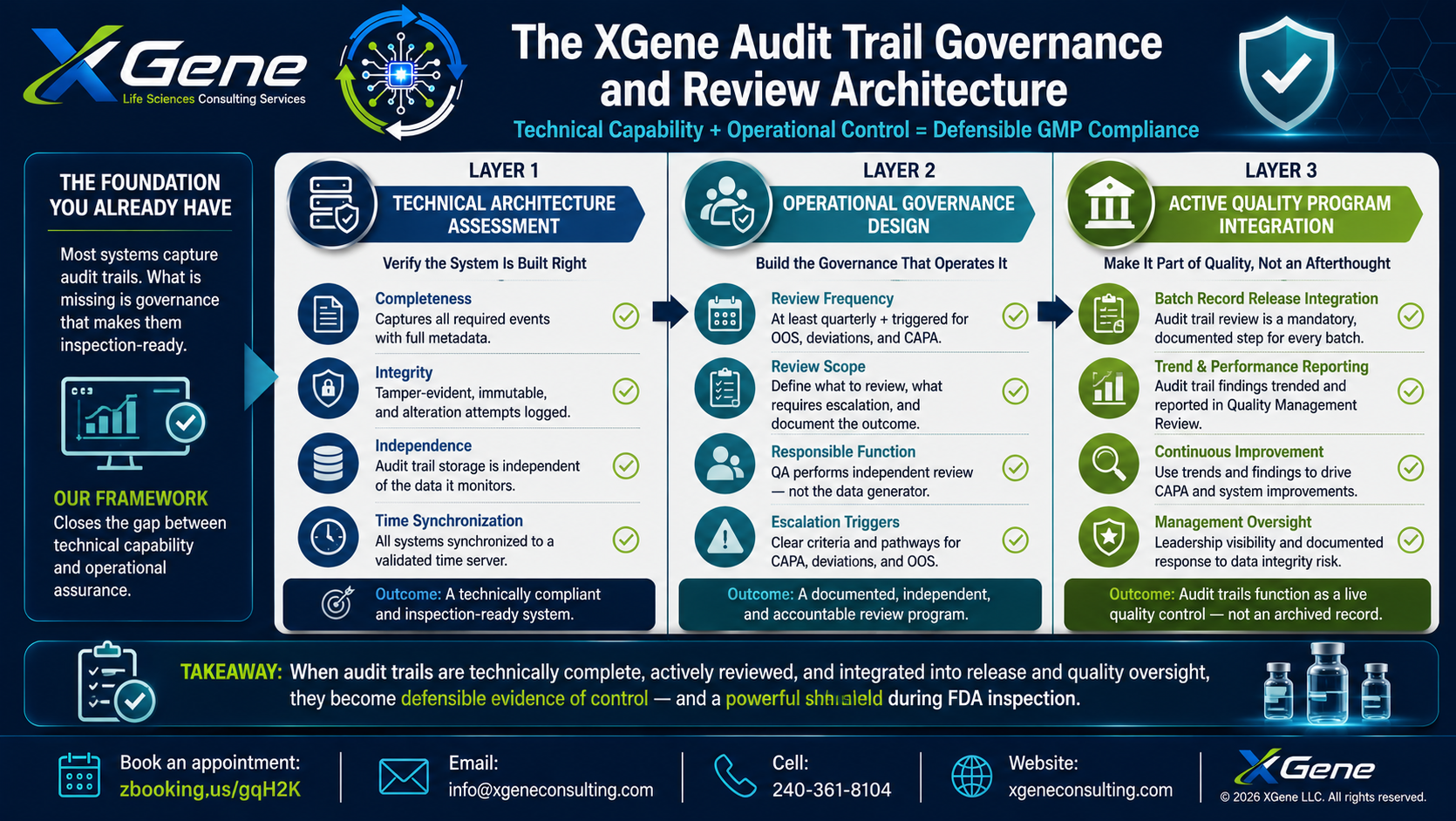
Technical Capability Plus Operational Control
The XGene Audit Trail Governance and Review Architecture is a three-layer program designed to close the gap between technical audit trail capability — which most facilities have — and the operational governance that transforms that capability into a defensible GMP control. The three layers operate in sequence during the program assessment and in parallel during ongoing operations: technical architecture assessment establishes the foundation; operational governance design defines the review program; and active quality program integration ensures that the audit trail functions as a live quality control rather than an archival record.
Layer 1 — Technical Architecture Assessment: The first layer evaluates every GMP electronic system that generates, modifies, or stores GMP-relevant electronic records against the minimum technical standard specified in 21 CFR Part 11.10(e), EU GMP Annex 11 Clause 9, GAMP 5, and the FDA and MHRA 2018 data integrity guidance. The assessment confirms five properties for each system: completeness — the audit trail captures all required event types (creation, modification, deletion, access for restricted data) with the full metadata field set (user ID, workstation ID, date/time stamp, event type, object affected, before value, after value, reason for change); integrity — the audit trail is tamper-evident and modification of the audit trail itself is detectable and captured; independence — audit trail storage is independent of the data records the audit trail monitors, and no user including administrators can disable or clear the audit trail without that action being logged in an indelible record; time synchronization — all GMP electronic systems are synchronized to a single validated time server, and the synchronization is documented, verified, and subject to deviation detection; and archive/restore — the audit trail design must permit native archival of data‐level audit trail entries independent of system‐level entries, and restoration of archived data must preserve chronological integrity and allow the restored data to be reviewed within the application or a validated viewer; the assessment confirms whether the system supports separate system and data audit trails, whether data‐level audit trails can be archived and restored without interleaving into the system audit trail, and whether audit trail review can be documented electronically within the system itself. Gaps identified at Layer 1 are categorized by regulatory risk tier and addressed through a prioritized remediation program with defined timelines. Critical gaps — audit trail disabled, time server absent, audit trail storage co-located with primary data — are treated as immediate CAPA actions. Significant gaps — missing metadata fields, audit trail configuration subject to admin override without logging — are addressed through validated system change control within a defined remediation window.
Layer 2 — Operational Governance Design: The second layer designs the review program that converts the technically compliant audit trail into an operational quality control. The governance design addresses four elements: review frequency — at minimum quarterly for all critical GMP electronic systems, with triggered reviews for all deviations, OOS results, and CAPA actions involving computerized systems; review scope — the audit trail review procedure defines exactly which event types are examined in each review cycle, what constitutes a finding requiring escalation, and how the review is documented to provide a traceable record of what was reviewed and what was found; responsible function — review responsibility is assigned to QA personnel who are organizationally and operationally independent of the data-generating function, with direct access to the audit trail without intermediation through laboratory or manufacturing management; and escalation triggers — the governance design specifies the criteria under which an audit trail finding is escalated to a CAPA, an OOS investigation, a deviation report, or a regulatory notification, and the escalation pathway must be documented in a procedure that is independent of the function whose audit trail generated the finding.
Layer 3 — Active Quality Program Integration: The third layer integrates audit trail review into the batch record release process and the periodic quality management system reporting structure. Batch record release integration means that audit trail review is a mandatory, documented step in the batch disposition process for every batch released from a GMP electronic system: the QA reviewer confirms, as a condition of disposition authorization, that the audit trail for the electronic records supporting the release decision has been reviewed for the scope defined in the Layer 2 governance design, that no unexplained modifications or deletions are present in the records supporting the disposition decision, and that the timestamps in the audit trail are consistent with the manufacturing batch timeline. The batch record contains a documented record of this review step — not a checkbox confirming that review occurred, but a documented finding confirming what was reviewed, who conducted the review, and what the outcome was. Periodic quality management reporting integrates audit trail trend analysis into the site quality management review on a defined cycle — at minimum annually, with trending of finding frequency, finding type, and remediation completion rates across systems and over time. Management reporting of audit trail trends serves two functions: it gives site leadership visibility into the data integrity risk profile of the electronic systems supporting manufacturing, and it creates a documented record that management has been informed of and has responded to audit trail governance performance — a record that becomes relevant if FDA inspection findings surface data integrity concerns that management accountability is expected to address.
The output of the XGene Audit Trail Governance and Review Architecture is a GMP quality system in which audit trail review is not a response to inspection preparation — it is a continuously operating quality control that has been running, with documented output, for every review cycle between inspections. That is the standard that distinguishes a defensible audit trail program from a technically capable one, and it is the standard that FDA investigators expect to find when they ask: “Can you show me the last audit trail review for this system, and when was the review before that, and the one before that?”
The distinction between a technically capable audit trail system and a defensible one is not a matter of software configuration or validation documentation. It is a matter of governance architecture and organizational commitment. The audit trail that has been running for five years, never reviewed, is not a compliance asset. It is a five-year record of everything your quality system missed, waiting for an investigator who will spend three days reading it. The audit trail that has been reviewed quarterly, integrated into every batch release, trended for patterns, and escalated through a documented governance program is the evidence that your quality system was functioning between inspections — not just during them. Those are two different companies, and FDA inspection experience makes clear which one they are when an investigator sits down with the system and starts asking questions.