
CMC Deficiency Letter Response Strategy: Turning FDA and EMA Questions Into Approval Accelerators
The average NDA CMC review cycle includes at least one round of deficiencies. The average ANDA review includes two. The companies that convert deficiency letters into expedited approvals are not…
On this pageArticle overview
The average NDA CMC review cycle includes at least one round of deficiencies. The average ANDA review includes two. The companies that convert deficiency letters into expedited approvals are not those with the fewest deficiencies — they are those whose response teams understand that a deficiency response is not a document submission. It is a regulatory negotiation with a defined decision architecture.
That reframing is not rhetorical. It has direct operational consequences for every decision made between the date a Complete Response Letter or an agency deficiency communication is received and the date the response is filed. Teams that treat the deficiency response as a data submission task — gather the data, write it up, submit it — generate second rounds of deficiencies from the same reviewer at a rate that is entirely predictable and entirely avoidable. The mechanism of failure is structural, not scientific. The data is usually adequate. The response architecture almost never is.
The Three Structural Failures That Generate Second-Round Deficiencies
Three structural failures generate the majority of second-round deficiencies in CMC submissions. Understanding them precisely is the prerequisite for building a response that closes a deficiency in one exchange.
The first structural failure is data provision without narrative context. A deficiency question is a regulatory question — it asks, implicitly or explicitly, whether a specific regulatory standard has been met. A response that provides data without connecting that data to the regulatory standard being questioned has not answered the question. It has provided evidence in search of a conclusion. FDA reviewers work within a scientific review framework that requires them to make a determination: does the information in the submission support approval? A response that gives a reviewer a stability table without stating explicitly that the data demonstrates compliance with ICH Q1A(R2) storage condition requirements, referencing the specific acceptance criteria and showing that all results fall within them, forces the reviewer to construct the compliance argument themselves. They may do so correctly, or they may identify a gap the applicant missed. Either outcome is inferior to a response in which the applicant makes the argument and the reviewer evaluates it. The second round of deficiencies is often the first round re-asked, with the question rephrased to indicate that data alone was insufficient.
The second structural failure is failure to acknowledge root cause. This failure is both the most consequential and the most consistently misunderstood in CMC response teams. When FDA or EMA identifies a gap in a submission — an unqualified impurity, a missing process validation batch, an inadequately justified specification limit — the deficiency question is a symptom of an underlying submission gap. A response that provides the missing data without acknowledging what was absent from the original submission, and why, signals to the reviewer that the applicant did not understand the original gap. That signal is not merely reputational. It is predictive: a reviewer who concludes that the applicant does not understand why a deficiency existed will look more carefully at adjacent sections, because the absence of root cause acknowledgment suggests the gap may be systemic rather than isolated. A single sentence — one sentence — that identifies what was missing or inadequate in the original submission demonstrates comprehension, not just compliance. It transforms the response from a document production exercise into a scientific dialogue.
The third structural failure is failure to assess cross-section impact. Module 3 is an interconnected document. The drug substance impurity profile described in S.3.2 informs the drug product impurity specification in P.5.1. The process validation data in S.2.5 supports the analytical method validation rationale in S.4.4. A response to a deficiency question on one section that does not assess whether the response data affects other Module 3 sections is a response that is incomplete by definition — and a reviewer who identifies the cross-section implication that the applicant missed will issue a second deficiency question on the section that was not updated. This failure is particularly common in multi-site submissions, where a manufacturing change response in one Drug Master File affects the drug product specifications filed by a separate applicant referencing that DMF, and the response team does not coordinate the update across the cross-referenced sections.
The FDA and EMA Deficiency Frameworks: Timelines, Classifications, and Meeting Strategy
FDA deficiency communications in NDA review are issued under 21 CFR 314.110, which governs Complete Response Letters. The CRL identifies deficiencies that must be addressed before approval. Under 21 CFR 314.110(b), applicants receiving a CRL have 12 months to respond in one of three ways: resubmit the application addressing each deficiency, withdraw the application, or request a hearing [citation:6]. The CRL was designed to describe all specific deficiencies identified and offer suggestions to address them [citation:6]. FDA’s review timeline for a resubmission ranges from two to six months depending on the significance of the changes [citation:6]. FDA classifies CMC deficiencies into three categories that carry direct implications for response strategy: major deficiencies require new data that was not in the original submission — process validation data, additional stability batches, impurity qualification studies; minor deficiencies require clarification or formatting correction to data already submitted; and requests for additional information indicate that the data exists in the submission but was not located or adequately cross-referenced by the reviewer. Each classification requires a structurally different response. A major deficiency response that treats the question as a minor clarification — providing a cross-reference to existing data when new data was explicitly requested — is one of the most reliable mechanisms for generating a second round.
The EMA deficiency procedure under the centralized procedure operates on a different timeline and a different grouping logic. Day 120 questions are issued after the initial assessment phase. The critical strategic decision at Day 120 is question grouping: some questions are designated as major outstanding issues and some as other concerns, and the applicant’s response must close the major outstanding issues completely, because unresolved major issues can generate a Day 180 Second List of Outstanding Issues (LoOI) that delays the opinion [citation:11]. In multi-site submissions — where a finished product is manufactured at one site, the active ingredient at another, and the primary packaging at a third — Day 120 deficiency responses frequently require coordinated amendments across multiple sections authored by separate regulatory teams in separate time zones. The EMA question grouping strategy must account for this coordination burden; a response to a manufacturing deficiency that is complete for the drug product site but incomplete for the drug substance site will not close the deficiency, regardless of how well the drug product response was written.
The most consequential strategic decision in responding to major CMC deficiencies — particularly under FDA review — is whether to submit a response directly or to request a Type B Pre-Submission Meeting before the response is filed. Under FDA PDUFA VII commitments, a Type B meeting is the appropriate mechanism for CMC alignment when the applicant is uncertain whether the proposed approach to addressing a major deficiency will satisfy the agency’s concern. The meeting request triggers a 60-day scheduling target from the date of receipt of the request [citation:10][citation:3], and the questions submitted in the meeting request become the basis for FDA’s written response — which, if the questions are drafted correctly, constitutes a pre-commitment from the agency on the acceptability of the proposed response approach. A Type B meeting that produces FDA agreement on the study design for a major deficiency response is worth the 60 days it costs. A major deficiency response submitted without that alignment, rejected in a second CRL, costs far more. FDA’s formal meetings with industry are governed by MAPP 4512.1, which establishes procedures for meeting requests and scheduling [citation:3][citation:9].
The Commitment Letter Strategy and Closing the Deficiency in One Round
The commitment letter as an alternative to data is an underused tool in major deficiency response strategy. For major deficiencies that require new stability data, process validation batches, or qualification studies that will not be available within a six-month response window, a commitment letter — a binding regulatory commitment to provide the data post-approval, with a specific protocol, timeline, and submission date — can be the basis for a conditional approval recommendation when the existing data provides sufficient confidence in safety and quality. FDA has accepted commitment letters in CMC contexts for post-approval stability data, long-term container closure compatibility data, and scale-up process validation batches, provided the applicant can demonstrate that the risk of proceeding without that data is appropriately managed by the existing submission package. This is not a mechanism for deferring data that should have been in the original submission. It is a mechanism for structured partial response when the deficiency involves data that can only be generated prospectively, and when the regulatory risk calculus supports proceeding with a binding commitment rather than delaying the response cycle by the time required to generate the complete dataset.
The XGene CMC Deficiency Response Architecture
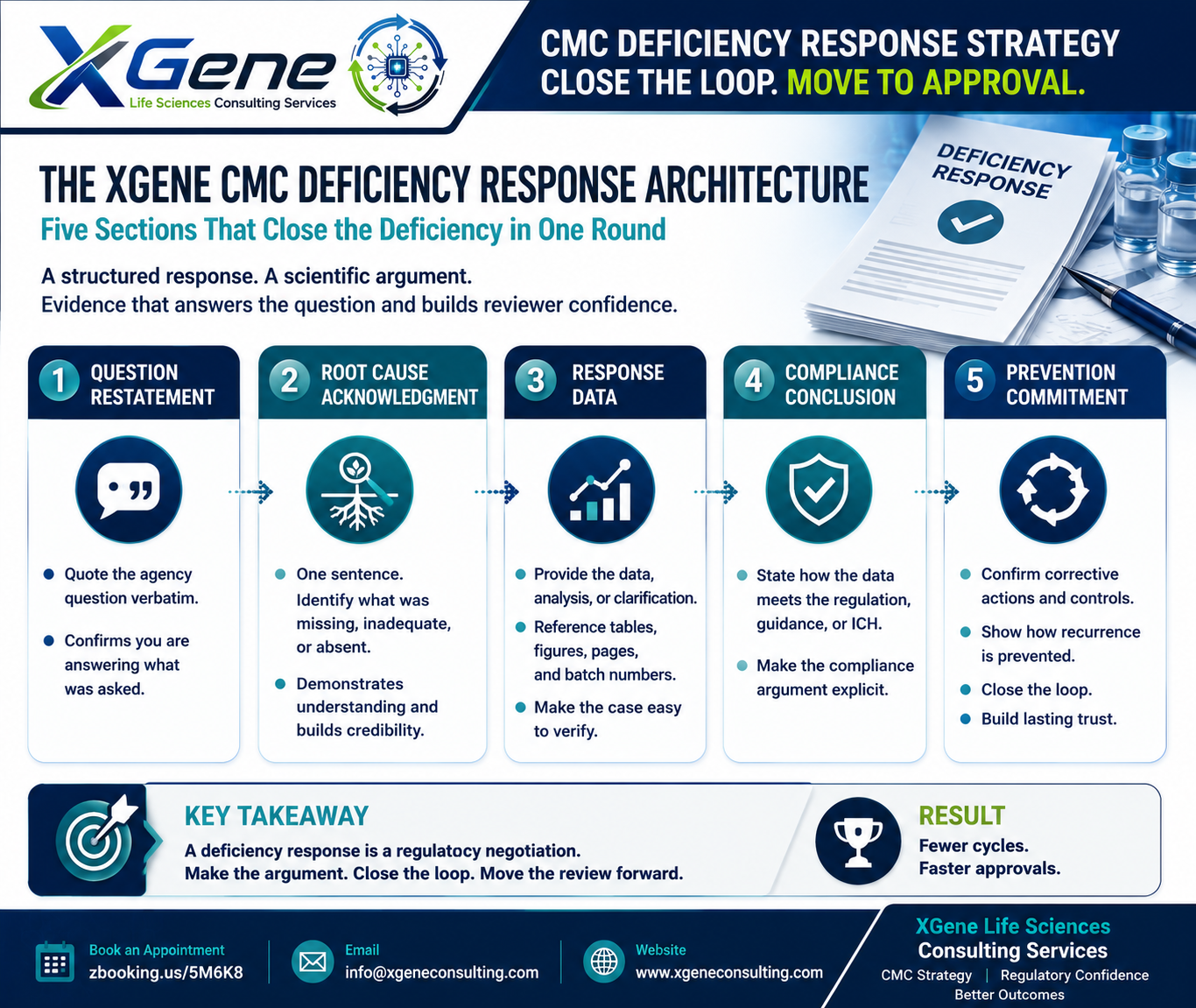
Five Sections That Close the Deficiency in One Round
1. QUESTION RESTATEMENT Reproduce the deficiency question verbatim from the agency communication. Do not paraphrase. Paraphrasing introduces the possibility of reframing the question in a direction the agency did not intend, and a reviewer who reads a paraphrased version of their own question will notice the shift. Verbatim restatement confirms that the response addresses what was asked, not what was expected to have been asked.
2. ROOT CAUSE ACKNOWLEDGMENT One sentence. Identify what was missing, inadequate, or absent from the original submission that generated this deficiency question. “The original submission did not include impurity qualification data for degradant XG-IMP-04 at the proposed specification limit of 0.15%.” This sentence demonstrates that the applicant understands the gap — not merely that they received the question. It transforms the response from reactive data provision into a scientific dialogue with the reviewer.
3. RESPONSE DATA Provide the specific data, analysis, or clarification that addresses the deficiency, with precision and cross-reference. Reference batch numbers, table numbers, figure numbers, and page locations within the response document. Do not reference Module 3 section numbers alone; reference the specific data element within that section. The compliance argument must be buildable from the citations in this section without opening any other document.
4. COMPLIANCE CONCLUSION An explicit statement that the response data demonstrates compliance with the specific regulation, guidance, or ICH guideline cited in, or implied by, the deficiency question. “The toxicological qualification data presented in Table 3 of this response, demonstrating acceptable safety margins at the proposed limit of 0.15% for degradant XG-IMP-04, satisfies the qualification threshold requirements of ICH Q3A(R2) Section 3.2 for new drug substances.” This sentence is the answer to the question. Everything before it is the evidence. Do not file a response that lacks this sentence.
5. CROSS-IMPACT ASSESSMENT Identify every other Module 3 section that contains information affected by the response data, and confirm that those sections have been updated in the current response submission. A deficiency response that changes the drug substance impurity specification must also update the drug product specification in P.5.1, the impurity discussion in the QOS at S.3.2, and the stability specification in S.7. The cross-impact assessment section documents that those updates were made, by section and by amendment number. A reviewer who asks about a cross-section implication that was not addressed has grounds for a second deficiency question that would not have existed if the cross-impact assessment had been completed.
The difference between a one-round deficiency resolution and a two-round cycle is almost never the quality of the underlying science. It is almost always the structure of the response document. A response that provides data without narrative, omits root cause acknowledgment, fails to state a compliance conclusion explicitly, and does not assess cross-section impact will generate a second round from a reviewer who had every intention of approving the response if the argument had been made. The architecture described above is not a bureaucratic formality. It is the document structure that allows a reviewer to do their job — to evaluate the response, make a determination, and move toward approval.