
Module 3 Deficiency Patterns — Why CMC Packages Fail at First Review
The most expensive regulatory event in drug development is not a clinical hold — it is a Complete Response Letter issued because the CMC package FDA received could not support…
On this pageArticle overview
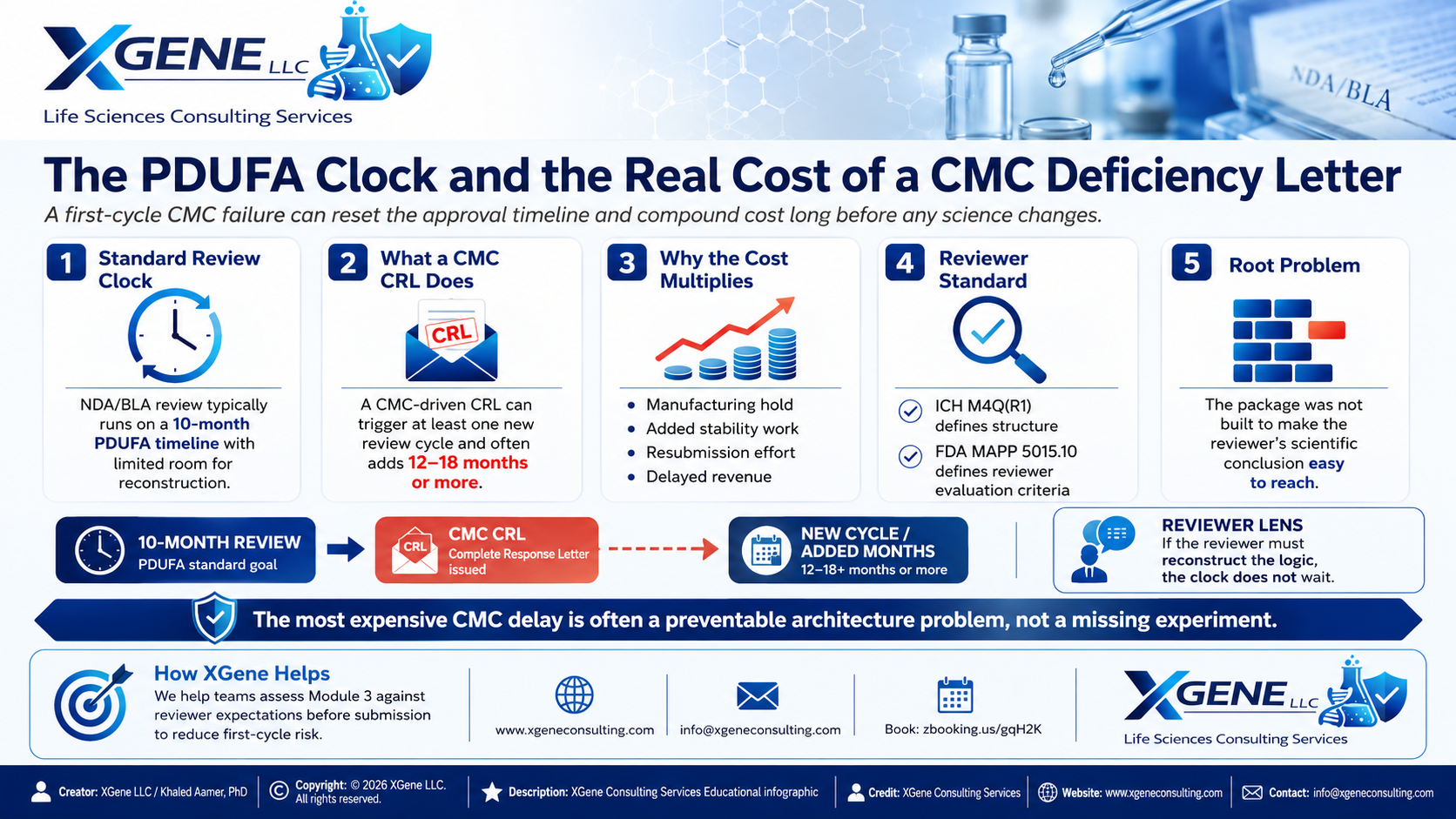
The most expensive regulatory event in drug development is not a clinical hold — it is a Complete Response Letter issued because the CMC package FDA received could not support the approval decision, requiring a new review cycle that costs 12 to 18 months.
A CRL under 21 CFR 314.110 for NDAs or 21 CFR 601.3 for BLAs does not return a program to a prior development stage — it resets the regulatory clock at the most capital-intensive point in a program’s life. The compounding costs of that reset — extended manufacturing hold, additional stability campaigns, resubmission preparation, and delayed commercial revenue — are well understood. What remains underappreciated is that the CMC deficiencies driving these letters are not scientific mysteries. They are architectural failures: documentation and narrative choices made during package construction that left the chemistry reviewer unable to reach an approvable conclusion from the data the sponsor provided.
Why CMC Packages Fail at First Review: The PDUFA Clock and the Deficiency Letter Cost
FDA’s standard NDA review cycle runs 10 months under PDUFA commitments — a timeline with defined milestones and a limited window for information requests. A CMC-driven CRL adds a minimum 6-month review cycle to that baseline, and that figure assumes the sponsor can respond rapidly with data that already exists and studies already complete. When the root cause is architectural — when the package was never structured to make the argument the reviewer needed to reach a conclusion — the actual extension is measured in years.
The framework governing what FDA expects is not ambiguous. ICH M4Q(R1) — the Common Technical Document for the Registration of Pharmaceuticals for Human Use: Quality — establishes the structural requirements for every CTD section, and FDA MAPP 5015.10 defines the specific criteria chemistry reviewers apply when evaluating each of those sections. MAPP 5015.10 is the closest public approximation of the checklist a reviewer uses to determine whether a CMC section is approvable. A sponsor team that has not read MAPP 5015.10 against its draft Module 3 is preparing a submission without knowledge of the evaluation standard it will be measured against — and the 10-month review clock will not pause while the reviewer waits for the author to reconstruct an argument that should have been built before submission.
The Seven Module 3 Sections With the Highest Deficiency Rates at FDA
Seven distinct deficiency categories account for the substantial majority of CMC CRL observations across review divisions and therapeutic modalities. They cluster predictably in the CTD sections where regulators expect documented scientific rationale — not merely data — and where the linkage between development decisions and commercial controls must be made explicit by the author, not inferred by the reviewer.
Specification justification in sections 3.2.S.4.1 and 3.2.P.5.1 is the most foundational category. The regulatory expectation, expressed through the ICH Q6A and Q6B decision trees, is that every acceptance criterion traces to one of three defensible justifications: a clinically or safety-relevant threshold, a manufacturing capability limit supported by process characterization data, or a pharmacopoeial standard applied with documented rationale specific to this product. Specifications set to match Phase 3 batch results — confusing observed historical performance with scientifically justified limits — do not satisfy this standard, and the response to a deficiency requires reconstructing the rationale architecture that the original submission never built.
Impurity characterization and qualification — sections 3.2.S.3.2 and 3.2.P.5.6 — generates deficiencies that are distinct from specification justification and are routinely conflated with it. The regulatory threshold at which toxicological qualification is required is codified in ICH Q3A(R2) for drug substances and ICH Q3B(R2) for drug products: any degradation product present above 0.15% or 1.0 mg total daily intake — whichever is lower — must be qualified by a toxicological study or a clinical safety argument referencing the approved clinical database. An impurity limit set above this threshold may carry a fully documented manufacturing capability rationale satisfying the specification justification criterion while the characterization section contains no qualification argument at all. These are two different regulatory requirements answering two different questions, and a submission that answers one without addressing the other generates a standalone qualification deficiency the specification rationale cannot resolve.
Analytical method validation — sections 3.2.S.4.2 and 3.2.P.5.2 — surfaces ICH Q2(R1/R2) gaps most destructively when specificity for degradation products is marked pending at the time of submission. That single study gap propagates across three sections: the reviewer cannot accept the impurity limit as analytically validated, the qualification rationale for that degradant cannot be confirmed against validated data, and stability results generated with that method are technically unvalidated. One incomplete specificity study creates a cascade of linked deficiencies that individually each require a formal response.
Process validation linkage fails when CPPs identified in development sections 3.2.S.2.6 and 3.2.P.2 do not map explicitly to the process controls documented in 3.2.S.2.2 and 3.2.P.3.3. ICH Q8(R2) requires that development studies establish the scientific basis for the commercial process, and MAPP 5015.10 reviewers verify that every CPP operating range in the commercial manufacturing description can be traced to the characterization data that justified it. When the commercial process documents a control range that deviates from the studied range — without a documented scientific rationale for that deviation — the reviewer flags a linkage deficiency requiring a bridging argument that the author must now construct retroactively under the 6-month response clock.
Stability data integration in sections 3.2.S.7 and 3.2.P.8 fails when data from multiple studies is presented as individual reports rather than synthesized into a coherent degradation pathway analysis with a mechanistic or statistical basis for the proposed shelf life. The degradation pathway analysis is the argument; the study reports are its evidence. A submission that provides evidence without a synthesized argument leaves the reviewer unable to independently verify whether the proposed shelf life is supported — and they will issue a deficiency rather than construct the argument on the sponsor’s behalf.
Container closure system — section 3.2.P.7 — generates deficiencies that non-parenteral programs consistently underweight. Extractables and leachables data must be specific to the proposed commercial container closure system, proposed storage conditions, and proposed shelf life duration. Borrowing E&L data from a different product family or a different packaging configuration without a documented scientific justification for equivalence does not support the shelf life claim: the reviewer cannot determine whether the leachable profile at 24 or 36 months under commercial storage conditions has actually been characterized for this product in this container system.
Quality Overall Summary — Module 2.3 — generates deficiencies that authors underestimate because the QOS is treated as a summary document rather than an integrated scientific narrative. Under ICH M4Q(R1), the QOS must critically analyze the Module 3 data, not reformat its contents. When the specification table in Module 2.3 does not match 3.2.S.4.1 or 3.2.P.5.1 — in acceptance criterion value, method reference, or analytical procedure version — the reviewer has identified two incompatible versions of the specification within the same submission, and the CRL process exists specifically to compel the sponsor to resolve which is controlling.
What Reviewers Write in Deficiency Letters That Authors Don’t Anticipate
The language of a CMC deficiency letter is the language of a scientist who could not reach a scientific conclusion from the record presented — not an auditor noting a missing document. When a reviewer writes that “the applicant has not provided adequate justification for the proposed acceptance criterion for [specified impurity],” they are stating that the regulatory record does not support a scientific finding that the limit appropriately protects patient safety. The response must reconstruct the scientific argument — through the ICH Q6A decision tree, the ICH Q3A(R2) qualification threshold analysis, the clinical safety database, or the validated method range — not merely locate a document the author believes was already there.
The most consistently unanticipated deficiency pattern is the impurity qualification gap that authors do not recognize as categorically separate from the specification justification gap. A program team that has justified every specification criterion against process capability and pharmacopoeial standards may still receive a qualification deficiency for a degradant present above the 0.15% or 1.0 mg TDI threshold, because specification justification and toxicological qualification answer different regulatory questions. A submission that answers the first without the second generates a deficiency the first answer cannot close. Similarly, the QOS-to-Module 3 specification inconsistency — almost always a document control artifact generated when final specification revisions are not propagated back into the QOS tables — reads to the reviewer as two incompatible versions of the same regulatory record. Under MAPP 5015.10, that inconsistency is a reviewable deficiency regardless of which version reflects the sponsor’s actual intent.
⬛ THE XGENE MODULE 3 PRE-SUBMISSION AUDIT: CLOSING GAPS BEFORE THE REVIEWER FINDS THEM
The XGene Module 3 Architecture and Pre-Submission Review Framework is a structured four-step pre-submission methodology that applies the evaluation criteria of ICH M4Q(R1) and FDA MAPP 5015.10 to a sponsor’s draft Module 3 package before it reaches the agency — generating a prioritized deficiency risk register that allows every gap to be closed on the sponsor’s timeline rather than the CRL response clock.
Step 1 — Cross-Reference Verification Map: Construct a systematic table linking every data element appearing in more than one CTD section — specification values, batch formula quantities, CPP operating ranges, analytical procedure version numbers, and container closure system configurations — and verify internal consistency across all instances, including alignment between the 3.2.P.7 packaging configuration and the storage conditions and shelf life duration claimed in the stability sections.
Step 2 — Specification Justification and Impurity Qualification Audit: Evaluate every acceptance criterion in 3.2.S.4.1 and 3.2.P.5.1 against the ICH Q6A or Q6B decision tree logic; then independently verify that any impurity or degradation product present above the ICH Q3A(R2) or Q3B(R2) qualification threshold of 0.15% or 1.0 mg TDI is supported by a toxicological qualification study or a clinical safety argument citable to the approved clinical database — treating specification justification and impurity qualification as two distinct regulatory requirements requiring two distinct evidentiary responses.
Step 3 — CPP-to-Commercial Process Control Linkage Verification: Map every critical process parameter identified in development (3.2.S.2.6 / 3.2.P.2) to its corresponding process control in the commercial manufacturing sections (3.2.S.2.2 / 3.2.P.3.3), confirming that each commercial control range is traceable to the development characterization data that justified it and that any deviation from the studied range carries an explicit, citable scientific rationale — satisfying the ICH Q8(R2) requirement for knowledge-based process design before the reviewer encounters the gap.
Step 4 — Stability Integration and Container Closure Stress Test: Verify that stability data across all studies has been synthesized into a coherent degradation pathway analysis with a mechanistic or statistical basis for the proposed shelf life; confirm that all analytical methods are fully validated under ICH Q2(R1/R2) with no pending degradant-specificity studies outstanding; and verify that the 3.2.P.7 extractables and leachables data is specific to the proposed commercial container closure system under the proposed commercial storage conditions for the full proposed shelf life duration.
The output is a Module 3 Deficiency Risk Register — a section-by-section, prioritized document that identifies every gap in scientific justification, cross-reference consistency, and data integration, paired with the specific remediation action and the supporting record that closes each gap — delivered before the submission package leaves the sponsor’s hands.
A CMC-driven CRL is not a scientific failure — it is an architectural one. The science that would have supported approval existed in the program’s development record; it was simply not structured, cross-referenced, and narrated in a way that allowed a chemistry reviewer to reach an approvable conclusion within the standard 10-month review cycle. Every month of extension attributable to a CRL under 21 CFR 314.110 or 21 CFR 601.3 carries compounding cost: manufacturing hold, continued clinical program burn, competitive exposure, and the organizational burden of rebuilding a submission under deadline pressure. The architecture decision that determines which outcome a program experiences is made before the first section is written.
Open your Module 2.3 QOS specification table and compare every acceptance criterion against the corresponding 3.2.S.4.1 or 3.2.P.5.1 specification — are they identical, and can you trace each criterion to a documented scientific rationale in 3.2.P.2 or 3.2.S.2.6?