
Umendra Life Sciences Warning Letter: Component Testing Failures and the Talc-Asbestos Risk Every OTC CMC Director Must Recognize
On June 2, 2026, FDA issued Warning Letter 320-26-91 to Umendra Life Sciences Private Limited, an OTC drug product manufacturer located in Bavla, Ahmedabad, Gujarat, India, citing systemic failures in…
On this pageArticle overview
The 704(a)(4) Enforcement Context and Patient Safety Rationale
On June 2, 2026, FDA issued Warning Letter 320-26-91 to Umendra Life Sciences Private Limited, an OTC drug product manufacturer located in Bavla, Ahmedabad, Gujarat, India, citing systemic failures in incoming component testing and quality unit oversight that allowed talc — a component with a documented asbestos contamination risk — to enter finished drug product manufacturing without verification against current USP specifications. The letter, issued by Francis Godwin, Director of the Office of Manufacturing Quality within CDER, was triggered by records submitted under a section 704(a)(4) remote regulatory assessment, meaning FDA identified these violations without conducting a physical site inspection — a method that is now a normalized enforcement pathway for international manufacturers.
The Umendra case is not, at its surface, a novel enforcement pattern. But it carries a patient safety dimension that elevates it above a routine component testing deficiency: the drug products at issue are OTC formulations containing talc as an excipient — with FDA stating that for one formulation, talc exceeds a specific percentage of the finished product by weight (the exact figure is redacted as confidential in the publicly posted letter) — where the labeled use creates either inhalation exposure or application in anatomical areas that scientific literature has associated with increased cancer risk when asbestos-contaminated talc is involved. FDA explicitly cited the known human carcinogenicity of asbestos when inhaled and referenced published literature dating to the 1960s on the possible association between talc-containing OTC products used in the perineal area and ovarian cancer incidence. The safety framing is not incidental; it explains the severity of FDA’s response to what might otherwise appear to be a documentation or specification gap.
The Technical Failures: USP Monograph Non-Compliance and the IP vs. USP Pharmacopeia Gap
The primary observation, cited under 21 CFR 211.22, is that Umendra’s quality unit failed to ensure that test procedures and specifications for talc were scientifically sound and appropriate under 21 CFR 211.160(b). The specific procedural deficiencies documented in the letter constitute a complete failure across the talc component testing lifecycle. The contract laboratory conducting talc testing did not perform Atomic Absorption testing for Calcium or Assay Content of Magnesium — both required by the current USP talc monograph. For the identification testing that was performed, the IR spectroscopy report was generated across a wavenumber range that did not align with the USP identification procedure acceptance criteria, which requires evaluation of specific peak maxima at defined wavenumbers and an asbestos absence evaluation that includes scale expansions at required wavenumbers to identify the presence of tremolite, chlorite, and serpentines. Umendra’s spectral data did not include those expansions, did not identify the required peak maxima, and did not evaluate for the presence of serpentines within the relevant wavenumber range. The talc specifications also omitted required impurity limits and lacked certain identification procedures entirely. The quality unit approved all of this material for use in manufacturing.
The second observation, cited under 21 CFR 211.84(d)(1) and 21 CFR 211.84(d)(2), documents the supplier qualification dimension of the same failure. Umendra relied on certificates of analysis from its talc suppliers without establishing the reliability of those COAs through validation at appropriate intervals — the foundational CGMP requirement that makes supplier COA reliance permissible in the first place. Compounding the problem, the COAs reviewed by FDA indicated the material was characterized to Indian Pharmacopeia (IP) grade rather than USP grade. FDA’s review of the IP talc monograph found it lacks the assay requirements and several impurity limits present in the USP monograph, including the asbestos-specific testing provisions. A manufacturer supplying finished drug products for the US market cannot use IP-grade component specifications as a substitute for USP specifications; the two pharmacopeias are not equivalent for a regulated excipient with a known carcinogen contamination risk.
The pattern at Umendra reflects a failure mode that appears repeatedly in FDA enforcement at international OTC manufacturers: the quality unit’s oversight of contract testing laboratories is nominal rather than substantive. Under CGMP, a drug product manufacturer is responsible for the quality of its drugs regardless of agreements in place with contract facilities. FDA’s explicit framing in this letter — “FDA regards contractors as extensions of the manufacturer” — is not rhetorical; it is the agency’s statutory interpretation of 501(a)(2)(B) adulteration liability. The quality unit’s failure was not simply that the contract laboratory used wrong methods. The failure was that the Umendra quality unit reviewed, approved, and accepted testing data that, on its face, did not comply with the USP testing procedures it was supposed to satisfy. The gap between what the USP requires for IR identification and asbestos absence testing and what the submitted spectral data actually showed was visible in the data itself — not hidden in a laboratory audit trail or buried in raw data files. This represents a quality unit authorization failure, not just a testing gap.
Remediation Pathway: The Three Program Elements Every OTC CMC Director Must Audit Now
For CMC directors overseeing OTC formulations that include talc, the Umendra Warning Letter should trigger an immediate review of three program elements. First, confirm that your talc specification aligns with the current USP talc monograph in its entirety — including the asbestos absence test by IR spectroscopy, with the specific scale expansions and wavenumber evaluations the monograph requires. The USP has recently revised its talc monograph with updated technical requirements for asbestos testing, with the revised monograph scheduled to become official; any company still operating against an older version of the monograph is carrying regulatory exposure. Second, verify that your contract testing laboratory’s methods for talc have been reviewed and approved by your quality unit and that the laboratory is performing each test according to the current USP procedure — not a modified or abbreviated version. Third, assess whether your supplier COA validation program includes initial method equivalence verification and periodic revalidation at intervals that reflect the risk profile of the component; for a known carcinogen-susceptible excipient, the revalidation interval should be justified on safety grounds, not administrative convenience.
The ICH Q3A impurity threshold framework, while designed primarily for API impurity control in new drug substances, provides the conceptual architecture for understanding why specification gaps in excipient components carry disproportionate risk. For a drug product where the excipient comprises a large proportion of the formulation weight, an impurity in the excipient — even at trace levels — can produce patient exposure that dwarfs what the same impurity concentration in a minor formulation component would deliver. Asbestos does not have a safe intake threshold; any validated presence in a finished drug product establishes a reportable safety event. Umendra’s formulation geometry — where FDA’s letter documents talc at a substantial (redacted) percentage of one product’s composition — means the absence of validated asbestos testing is not a specification documentation gap. It is a potential uncontrolled patient safety exposure.
XGene Practical Implementation Framework for Talc Component Qualification Programs
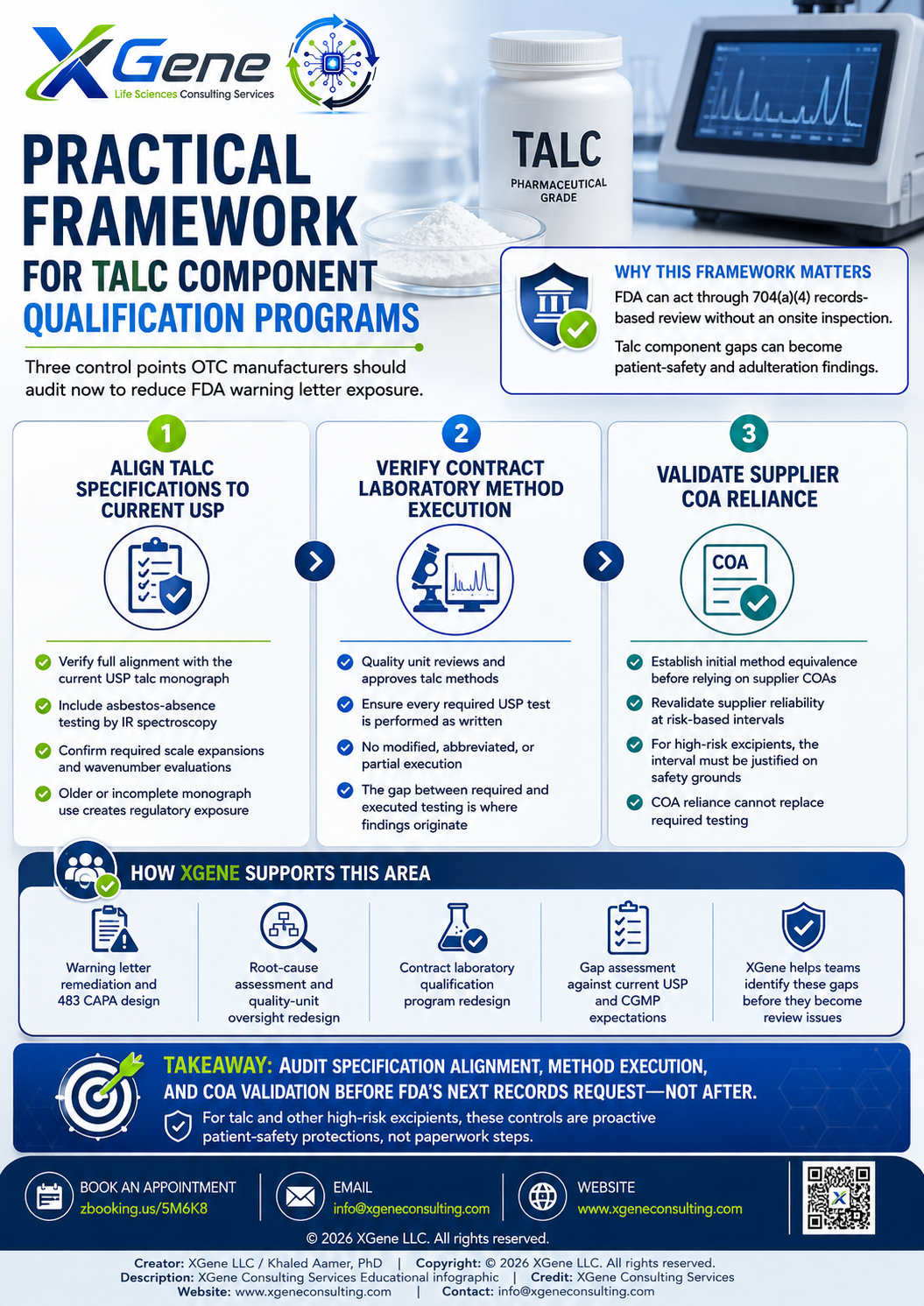
Companies managing similar component qualification programs, particularly international manufacturers supplying OTC drug products to the US market under contract or own-label arrangements, face the enforcement risk that Umendra’s case illustrates: FDA’s 704(a)(4) remote assessment authority allows CDER to evaluate records-based CGMP compliance without a physical inspection, and the adulteration finding under 501(a)(2)(B) can be made on that basis alone. The remediation pathway out of this finding requires a comprehensive quality unit restructuring that goes beyond correcting the specific assay gap — it requires demonstrating that the quality unit has the authority, the technical resources, and the oversight mechanisms to evaluate, approve, and verify contract laboratory testing against current pharmacopeial and CGMP standards prospectively, not retrospectively.
Three program elements every OTC CMC director should audit immediately:
1. USP Talc Specification Alignment: Confirm your talc specification aligns with the current USP talc monograph in its entirety — including the asbestos absence test by IR spectroscopy, with the specific scale expansions and wavenumber evaluations the monograph requires. The USP has recently revised its talc monograph with updated technical requirements for asbestos testing; any company still operating against an older version of the monograph is carrying regulatory exposure.
2. Contract Laboratory Method Verification: Verify that your contract testing laboratory’s methods for talc have been reviewed and approved by your quality unit and that the laboratory is performing each test according to the current USP procedure — not a modified or abbreviated version. The gap between what the USP requires and what the laboratory actually executes is where enforcement findings originate.
3. Supplier COA Validation Program: Assess whether your supplier COA validation program includes initial method equivalence verification and periodic revalidation at intervals that reflect the risk profile of the component. For a known carcinogen-susceptible excipient, the revalidation interval should be justified on safety grounds, not administrative convenience.
Warning Letter remediation and 483 CAPA design at this level — root cause assessment, contract laboratory qualification program redesign, and gap analysis against current USP specifications — is precisely the work XGene Consulting undertakes with international manufacturers navigating FDA enforcement responses. If your quality system has exposure in any of the component testing areas this Warning Letter identifies, the time to address it is before FDA’s next records request, not after. Connect with me at xgeneconsulting.com or on LinkedIn to discuss where your program stands.